
The impact of UV rays on the skin microbiome
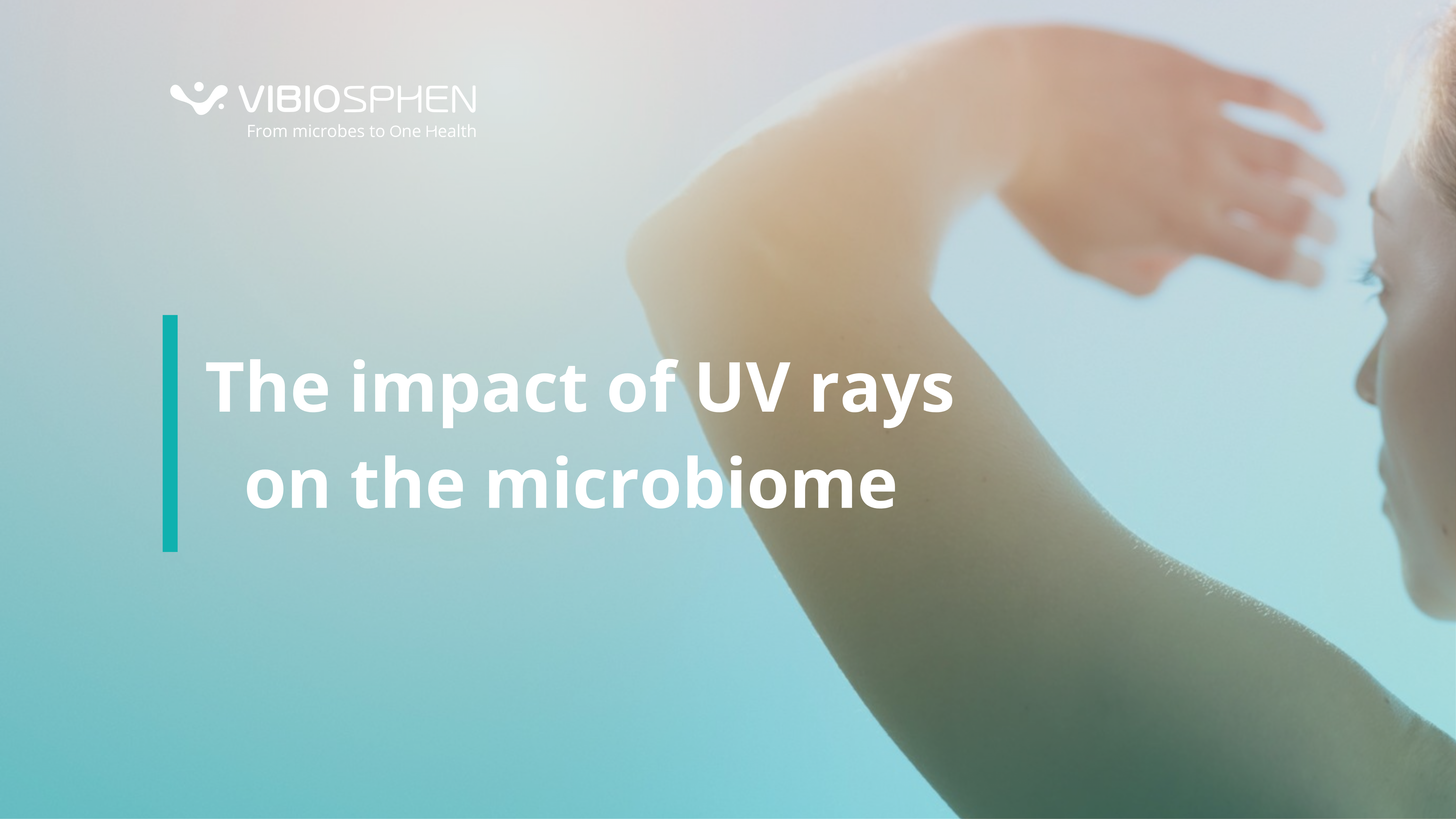
With the warmer weather just around the corner, why not take a moment to discuss the impact of UV rays on the microbiome?
The human skin is home to a multitude of commensal microorganisms (bacteria, fungi, viruses, parasites) that make up the skin microbiome. This collection of microorganisms interacts with skin cells and immune system cells to maintain skin homeostasis. At the same time, the human skin and its microbiome are subject to external and environmental stressors, such as ultraviolet light (UV).
Indeed, exposure to UV rays, primarily UVA and UVB, is one of the major environmental factors influencing the skin microbiome (3). UV radiation can have both direct effects on microorganisms and indirect effects via the host’s immune system.
1. Direct effects of UV on microorganisms
UV radiation can damage the microbial community in several ways, notably by inducing DNA damage. As with human cells, UV causes DNA damage in microbes (formation of pyrimidine dimers), which can alter the genetic composition of the species present on the skin’s surface, thereby disrupting the healthy microbiome (2).
That said, not all microorganisms respond in the same way to the effects of UV.
- Bacteria: UV radiation (UV-R) reduces Cutibacterium acnes’s porphyrin production, even at doses that do not cause detectable skin damage (2).
- Fungi: UV-R inhibits the growth of Malassezia furfur. Certain strains of Malassezia also produce pityriacitrin, a compound that acts as a natural UV filter to protect itself (2).
- Viruses: UV light also plays a role in the reactivation of latent viruses, such as the herpes simplex virus (HSV)(2).
2. Indirect interactions via the immune system
UV light modulates the cutaneous immune system, which in turn influences the microbiome.
- Production of antimicrobial peptides: Exposure to UV light modulates the expression of Antimicrobial Peptides (AMPs) (2). These peptides help maintain microbial homeostasis whilst protecting against pathogenic invaders.
- Modulation of immunosuppression: UV induces local immunosuppression. Paradoxically, a study has shown that the absence of the microbiome increases UV-induced immunosuppression, suggesting that the normal microbiome helps to temper this response and protects immune function (1).
- Microbial signals (PAMPs): Direct damage caused by UV to microbes can release pathogen-associated molecular patterns (PAMPs) that interfere with the host’s immune signaling cascades (2).
- Urocanic acid (UCA): trans-UCA, which is naturally present in the stratum corneum of the skin, undergoes cis-UCA isomerisation upon exposure to UVB radiation. Cis-UCA acts as a potent mediator of immunosuppression that the microbiome use as a resource, which in turn regulates and mitigates the impact of UV radiation on the host’s immune functions (2,4).
Ultimately, UV exposure not only affects the skin directly, it also disrupts its microbiome. To protect against UV-induced damage, probiotics and prebiotics appear to be highly promising therapeutic strategies (1).
Sources:
(1) Patra V, Gallais Sérézal I, Wolf P. Potential of Skin Microbiome, Pro- and/or Pre-Biotics to Affect Local Cutaneous Responses to UV Exposure. Nutrients. juin 2020;12(6):1795. doi:10.3390/nu12061795
(2) Patra V, Byrne SN, Wolf P. The Skin Microbiome: Is It Affected by UV-induced Immune Suppression? Front Microbiol. 10 août 2016;7. doi:10.3389/fmicb.2016.01235
(3) Burns EM, Ahmed H, Isedeh PN, Kohli I, Pol WVD, Shaheen A, et al. Ultraviolet radiation, both UVA and UVB, influences the composition of the skin microbiome [Internet]. doi:10.1111/exd.13854
(4) Patra V, Trajanoski S, Joshi A, Lenief V, Goyet C, Cornu A, et al. Urocanase-Positive Skin-Resident Bacteria Metabolize cis-Urocanic Acid and in Turn Reduce the Immunosuppressive Properties of UVR. J Invest Dermatol. nov 2025;145(11):2839-2853.e6. doi:10.1016/j.jid.2025.03.035
Catégories
Archives
- juillet 2026 (1)
- juin 2026 (1)
- avril 2026 (1)
- mars 2026 (2)
- février 2026 (2)
- janvier 2026 (2)
- octobre 2025 (1)
- juillet 2025 (1)
- juin 2025 (3)
- mai 2025 (1)
- mars 2025 (1)
- mai 2024 (1)
- avril 2024 (2)
- septembre 2023 (1)
- août 2023 (1)
- mai 2023 (1)
- avril 2023 (2)
- février 2023 (1)
- décembre 2022 (1)
- octobre 2022 (1)
- juin 2022 (1)
- mai 2022 (3)
- avril 2022 (1)
- février 2022 (2)
- janvier 2022 (3)
- décembre 2021 (2)
- novembre 2021 (1)