
Dandruff: why Malassezia is not the only answer
Dandruff remains one of the most common scalp conditions worldwide, affecting a large proportion of adults regardless of ethnic background. For years, it has been mainly associated with Malassezia overgrowth. Yet recent evidence shows that dandruff is more complex than a simple fungal imbalance. It reflects a broader disruption of the scalp ecosystem, where fungi, bacteria, and host factors all contribute to disease development.
At Vibiosphen, we believe that understanding this complexity is essential to designing more targeted and effective scalp solutions.
The scalp microbiome in health
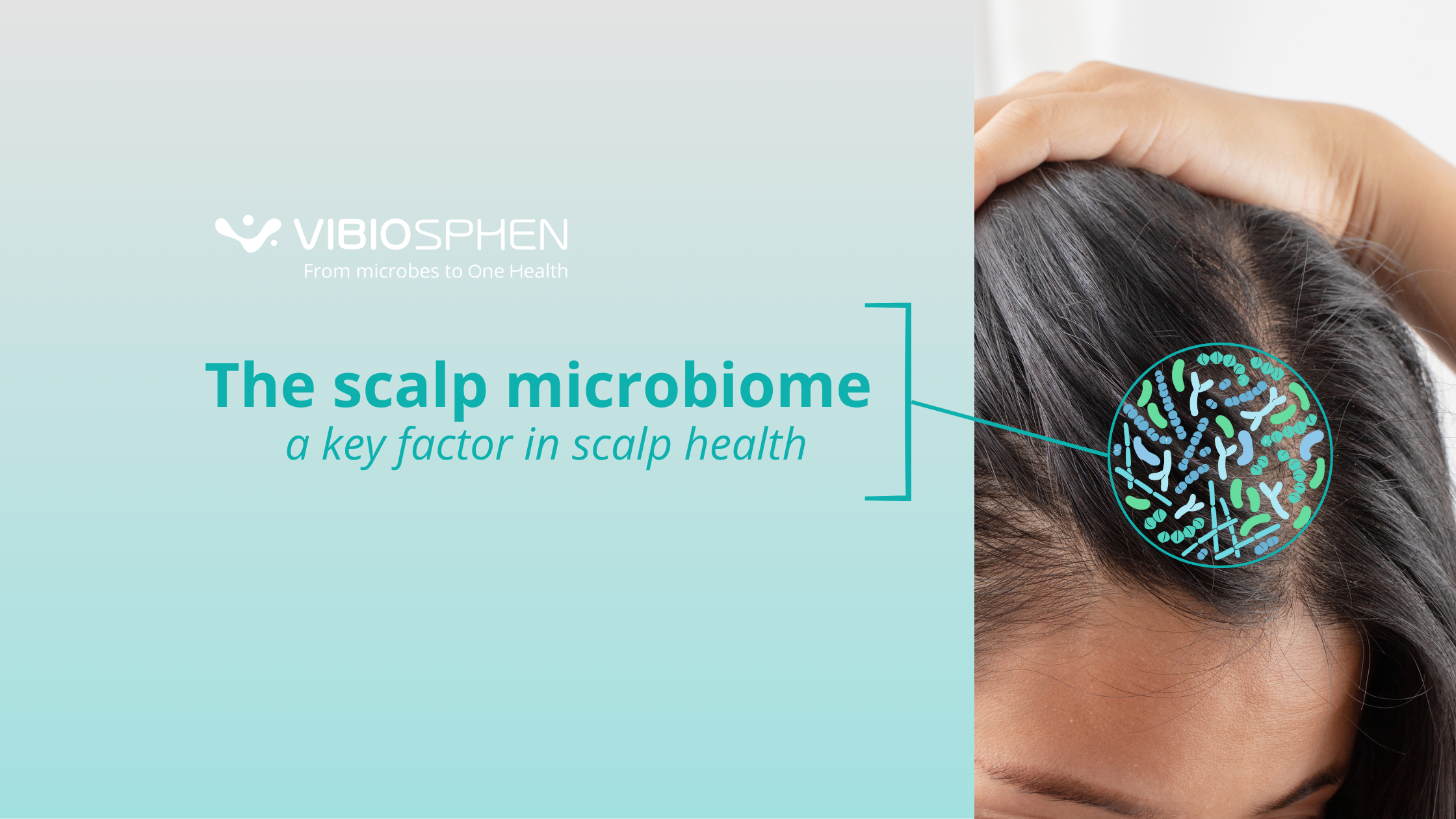
A healthy scalp is home to a dynamic microbial community. In balanced conditions, commensal bacteria such as Cutibacterium, Propionibacterium, and Staphylococcus epidermidis contribute to microbial homeostasis and help maintain scalp barrier function.
When this balance is disrupted, the scalp microbiome shifts toward dysbiosis. In dandruff, this change affects both fungal and bacterial populations, suggesting that the condition cannot be fully explained by a single microbial driver.
Malassezia still matters, but not everywhere
Analysis1 confirms that Malassezia remains an important player in dandruff, especially M. restricta. However, the association between Malassezia load and dandruff is not consistent across all ethnic groups.
In Asian participants, no clear difference in Malassezia or M. restricta abundance was observed between healthy and dandruff-affected scalps. This suggests that antifungal approaches alone may not be sufficient for every population, and that scalp care strategies need to account for microbiome variability.
Interestingly, the most consistent fungal change across groups was a lower abundance of M. globosa in dandruff-affected scalps, reinforcing the idea that dandruff involves selective microbial shifts rather than a uniform fungal overgrowth.
A strong bacterial signature in dandruff
One of the most important findings of this study1 is the role of the bacterial component. Across all ethnicities, dandruff scalps were associated with increased levels of Staphylococcus aureus. This increase was also positively correlated with dandruff presence and severity.
At the same time, healthy scalps tended to show higher abundance of commensal bacteria such as S. epidermidis and Cutibacterium species. In contrast, dandruff scalps displayed a decrease in these beneficial taxa, alongside enrichment in S. aureus and S. capitis.
These results suggest that dandruff is not only a fungal condition, but also a bacterial dysbiosis characterized by loss of commensals and expansion of potentially pathogenic species.
A more virulent microbiome
Beyond microbial composition, the functional potential of the scalp microbiome also changed in dandruff. We observed a higher abundance of bacterial virulence factors linked to biofilm formation, exotoxin production, stress survival, motility, immune modulation, and other pathogenic functions.
This functional profile was especially pronounced in Hispanic/Latino and Asian cohorts, where higher levels of Staphylococcus species were detected. These data suggest that dandruff is associated not only with microbial imbalance, but also with a more virulent microbial environment.
Ethnicity and scalp diversity
A key strength of this study is the inclusion of diverse ethnic groups. The results show that scalp microbiome signatures differ across populations, both in healthy and dandruff-affected individuals.
These differences highlight the need for inclusive research and tailored solutions. A better understanding of ethnicity-related microbiome patterns may help identify more precise approaches to dandruff management and support the development of personalized scalp care strategies.
Toward more targeted scalp solutions
Taken together, these findings support a shift in dandruff management strategy. Rather than focusing only on broad antifungal activity, future solutions should consider:
Selective targeting of dandruff-associated microbes.
Restoration of bacterial and fungal balance.
Support of scalp barrier function.
Adaptation to population-specific microbiome profiles.
This broader approach is more consistent with the biological complexity of dandruff and may open the way to more effective and more personalized solutions.
Vibiosphen perspective
At Vibiosphen, we develop advanced preclinical models to better capture host-microbiome interactions and support the design of targeted dermocosmetic innovations.
Our work is driven by a simple goal: to help translate microbiome science into meaningful solutions for skin and scalp health.
Dandruff should now be seen as a multifactorial scalp condition shaped by the interplay between fungi, bacteria, and host biology. While Malassezia remains an important contributor, the bacterial component especially Staphylococcus aureus appears to play a central role in severity and microbial virulence.
By moving beyond a single-microbe view of dandruff, we can better understand scalp dysbiosis and develop more precise, microbiome-driven strategies for long-term scalp health.
Bibliography :
If Malassezia wasn't the only determining factor in dandruff: the role of scalp bacterial profile and ethnicity
Catégories
Archives
- juin 2026 (1)
- avril 2026 (1)
- mars 2026 (2)
- février 2026 (2)
- janvier 2026 (2)
- octobre 2025 (1)
- juillet 2025 (1)
- juin 2025 (3)
- mai 2025 (1)
- mars 2025 (1)
- mai 2024 (1)
- avril 2024 (2)
- septembre 2023 (1)
- août 2023 (1)
- mai 2023 (1)
- avril 2023 (2)
- février 2023 (1)
- décembre 2022 (1)
- octobre 2022 (1)
- juin 2022 (1)
- mai 2022 (3)
- avril 2022 (1)
- février 2022 (2)
- janvier 2022 (3)
- décembre 2021 (2)
- novembre 2021 (1)