
Determination of Minimum bactericidal concentration (MBC)
In vitro testing Microbiology powered
Background of Minimum bactericidal concentration (MBC)
The Minimum Bactericidal Concentration (MBC) is the lowest concentration of an antimicrobial agent needed to kill at least 99.9% of a specific bacterial population after a defined period of incubation.
While the Minimum Inhibitory Concentration (MIC) is the minimum concentration that prevents visible growth, the MBC is the minimum concentration needed to achieve a lethal effect.
An antimicrobial agent is considered bactericidal if its MBC is close to its MIC (typically MBC ≤ 4 x MIC). If the MBC is significantly higher, the drug is considered bacteriostatic, meaning it inhibits growth but doesn't necessarily kill the bacteria.
To ensure a successful outcome, the concentration of the drug at the site of infection must reach bactericidal levels. If a drug is not administered at a high enough concentration to reach its MBC, the infection may not be fully eradicated, leading to treatment failure, relapse, and potentially the development of antimicrobial resistance.
Objectives of the model
- To determine the MBC of antibiotics and antifungals in development
Our approach at Vibiosphen
After the MIC is determined, the MBC assay begins.
From the wells that showed no visible growth (i.e., those at MIC, MIC x 2 and MIC x 4), a small volume of the bacterial suspension is plated onto a fresh solid growth medium.
The plates are then incubated under the same conditions as the initial MIC assay and then are examined for bacterial growth.
Outcomes of Minimum bactericidal concentration (MBC)
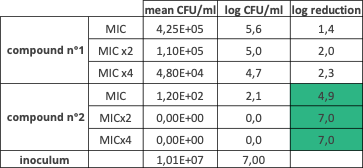
3-log reduction corresponds to a 99.9% killing of microorganisms (=MBC)
Compound n°1 appears bacteriostatic.
Compound n°2 appears bactericidal.