
Time Kill Curve (TKC)
In vitro/ex vivo testing Antibacterial and antifungal
Background of time kill curve assay (TKC)
- Traditionally dose and drug selection in antimicrobial therapy is based on a single static in vitro parameter, i.e. the MIC (minimal inhibitory concentration).
- However, an in vivo antimicrobial effect is rather the result of a dynamic exposure of the infective agent to the unbound antibiotic drug fraction at the relevant effect site.
- To systematically elucidate the dynamic relationship between bacteria and anti-infectives, pharmacokinetic-pharmacodynamic models based on time-kill curves were developed.
- Time-kill curves can follow microbial killing and growth as a function of both time and antibiotic concentration
Objectives of the model
To assess the potential bacterial inhibitor activity of a compound on Cutibacterium acnes and C. granulosum growths.
Our approach at Vibiosphen
- Bacterial cells were incubated with 3 concentrations of the compound.
- At T0, T+4h, T+8h, T+24h, T+32h and T+48h viable bacteria were quantified by serial dilutions, plating on agar plates and quantification of colony forming units (CFU).
Outcomes of the time kill curve assay
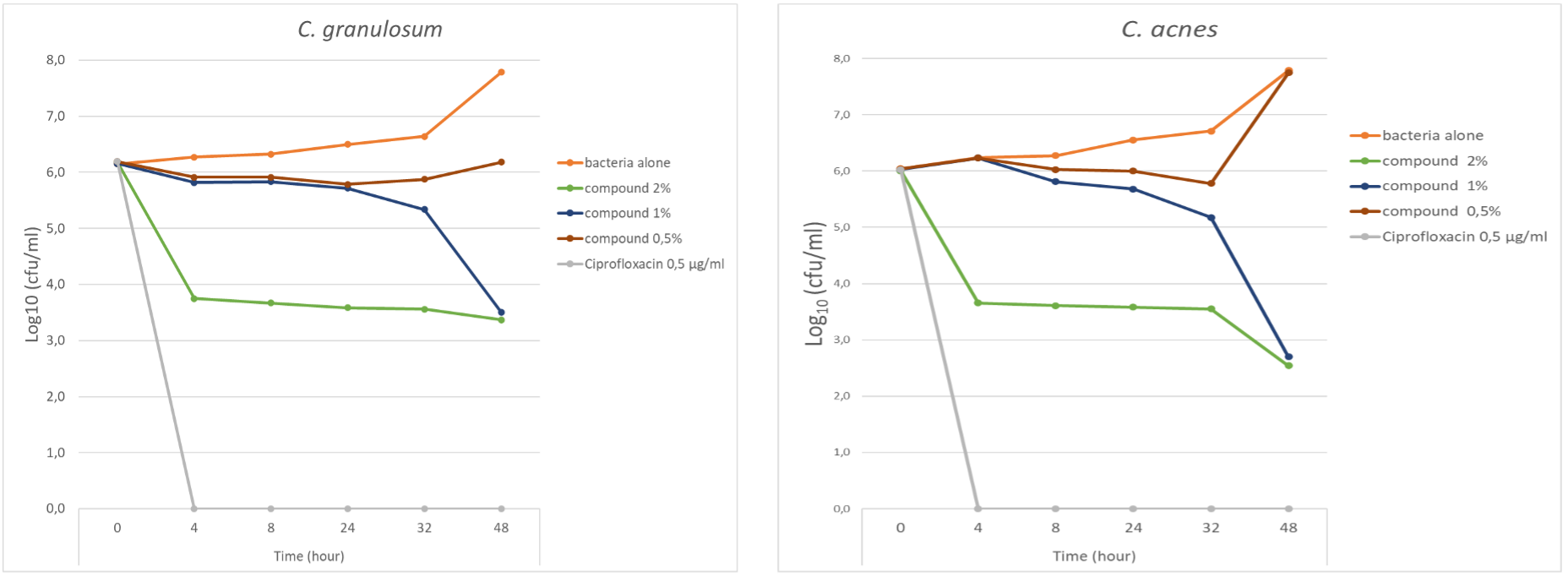
Dynamic pharmacokinetic-pharmacodynamic approach based on kill curves is a more rational approach to describe drug-bacteria interactions than the classical MIC approach.