
Turbidity reduction assay
In vitro/ex vivo testing Antibacterial and antifungal
A turbidity reduction assay is employed to assess the capacity of a treatment to decrease the optical density of a microbial suspension. In microbiological applications, turbidity primarily reflects the presence of suspended microbial cells. A reduction in turbidity may therefore indicate a decrease in suspended biomass resulting from microbial growth inhibition, cell death, cell lysis, aggregation or sedimentation.
When the turbidity reduction assay is used for bacteriophages, it is mainly applied to assess whether a phage can infect and lyse a given bacterial strain.
In this context, it is often called a phage lysis assay, turbidity assay, or optical density reduction assay.
A lytic phage infects susceptible bacteria, replicates inside them, and causes bacterial lysis. As bacterial cells are destroyed, the culture becomes less turbid or fails to increase in turbidity.

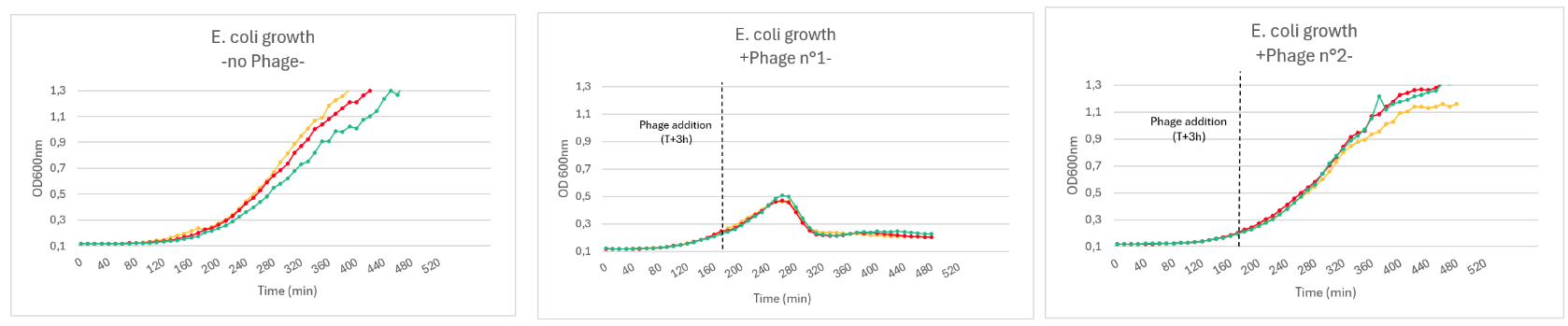
Impact of different bacteriophages on E. coli growth dynamics following addition at T+3h