
Model of in vitro human scalp microbiota
In vitro testing Microbiology powered
Background of Model of in vitro human scalp microbiota
• Based on 454 sequencing of the scalp microbiome, the two most abundant bacterial genera found on the scalp surface are Staphylococcus and Cutibacterium, while Malassezia is the main fungal inhabitant (Grimshaw et al., 2019).
• The human scalp hosts an unusually low diversity microbiota dominated by three species: S. epidermidis, C. acnes and M. restricta.
• The scalp microbiome constitutes an ecological system where species interactions have the potential to impact the efficacy of drugs or ingredients applied on skin and to contribute to health outcomes.
Objectives of the model
• To establish a new experimental model system that supports the growth of all three species in vitro and allows one to selectively enumerate each species from co-cultures.
Our approach at Vibiosphen
• The 3 microbial species were grown individually and then mixed.
• The mixture (and mono-cocultures) was grown in triplicates in D20 broth (Bhattacharya et al., 2023) (D0).
• At D+1, D+2, D+3 and D+6 the composition of the co-cultures (and mono-cultures) was determined by plating serial dilutions on selective medium to enumerate each microbial species.
Outcomes of Model of in vitro human scalp microbiota
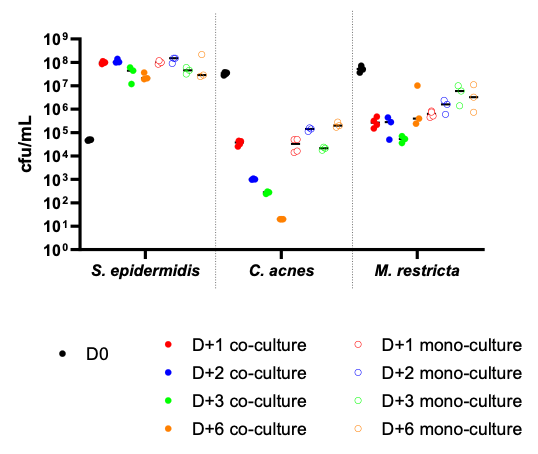
-S. epidermidis grows similarly whether it is present alone or together with C. acnes and M. restricta.
-C. acnes’s CFU increase slightly from D+1 to D+6 by 1 log10 when grown alone. On the contrary, the number of CFU sharply decreases when it is grown in co-culture.
- M. restricta’s CFU increase slightly from D+1 to D+6 by 1 log10 when grown alone or in co-culture.
This model of co-culture allows the establishment of ecological systems in which interactions between species are revealed.
We also offer a model where the microbiota is established on agar plate.
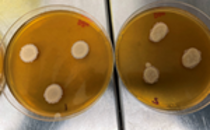
We can develop customized models of synthetic microbiota composed of microbial species of interest.