CDC’s 2026 Antimicrobial Resistance Threats Report: FromSurveillance Priorities to Preclinical Decisions
The CDC’s updated threat assessment reveals thescale of antimicrobial resistance in the United States. At Vibiosphen, thosesurveillance priorities meet an established portfolio of infection models and aflexible approach to assay development.
A renewed view of antimicrobial resistance
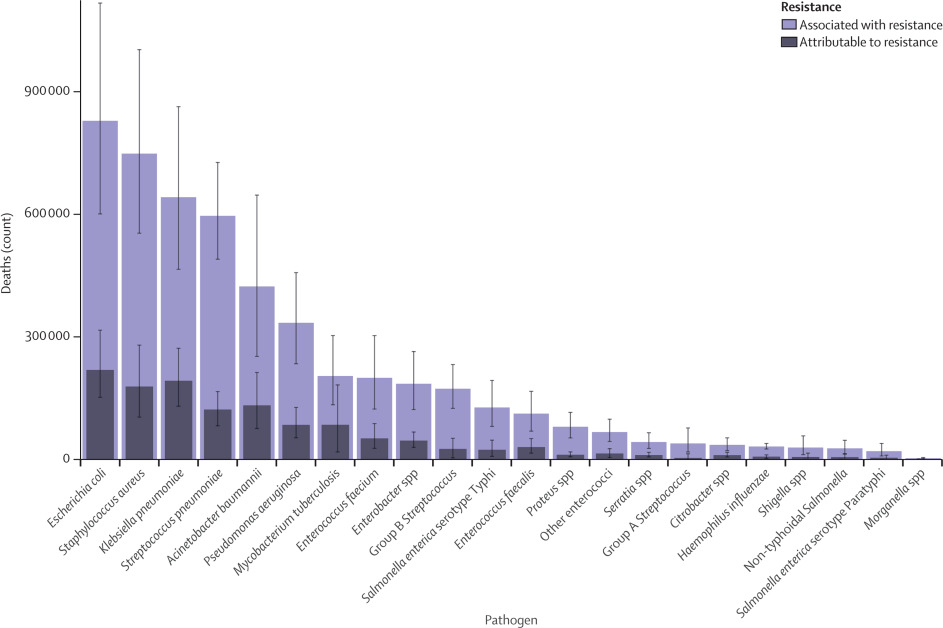
On 27 October 2026, the U.S. Centers forDisease Control and Prevention (CDC) published its updated AntimicrobialResistance Threats Report. Using 2023 burden estimates, the report attributesapproximately 9.7 million infections and 50,800 deaths annually in the UnitedStates to the pathogens included in its threat assessment [1,2].
These totals include Clostridioidesdifficile, a major infection linked to antibiotic use that is not typicallyclassified as drug-resistant. Excluding C. difficile, the CDC estimates morethan 9.3 million drug-resistant infections and more than 39,000 associateddeaths each year [2]. The distinction matters: the report captures bothresistant infections and a closely related consequence of antimicrobial use.
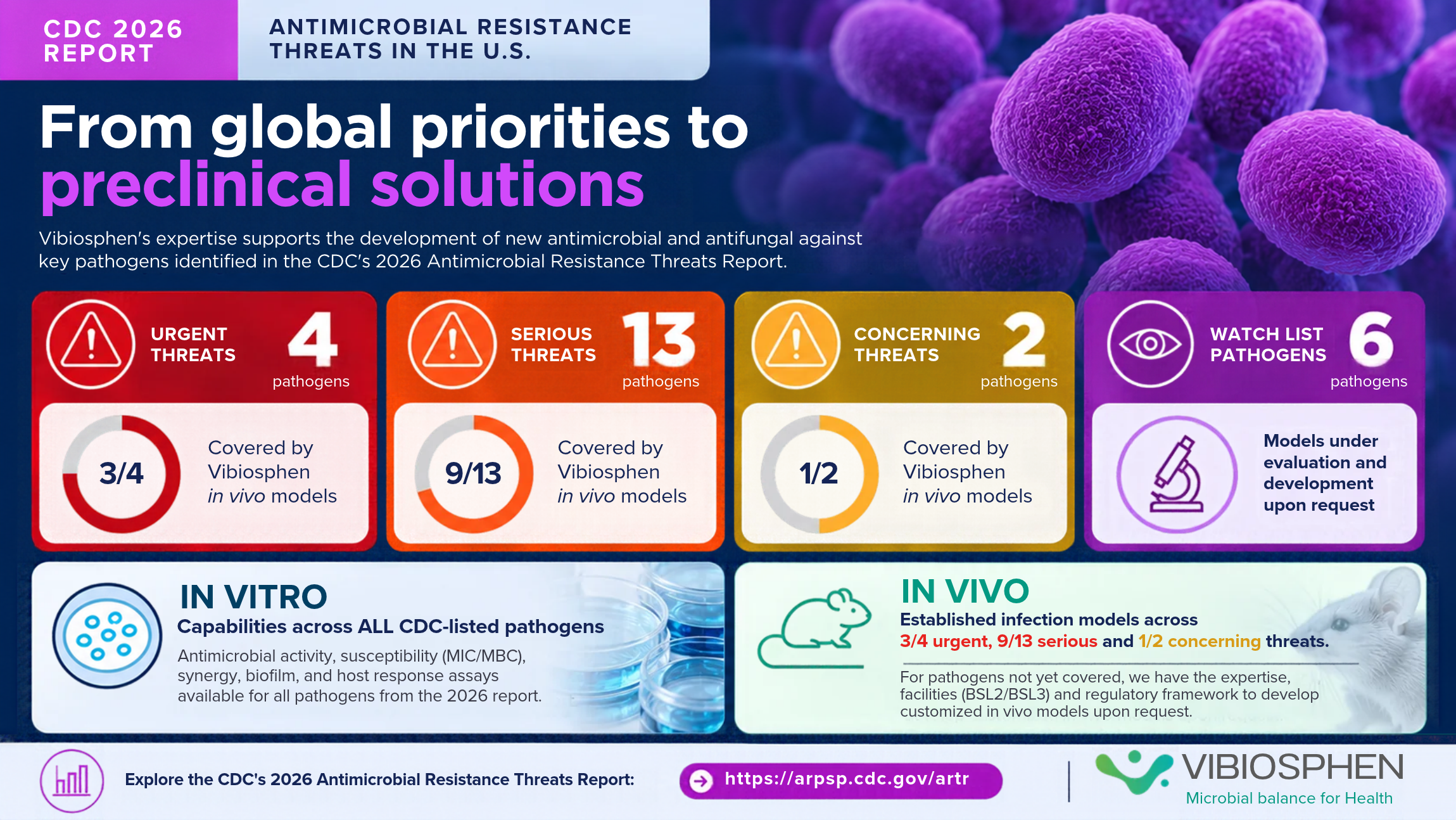
The CDC organizes 19 threats into fourUrgent, thirteen Serious and two Concerning categories, while six additionalpathogens appear on a Watch List [1]. This classification is not simply aranking of organisms. It integrates clinical burden, transmissibility,prevention, resistance trends and treatment availability to help guide actionin the United States [1].
Why threat surveillance must connect with experimentalevidence
Surveillance identifies where the pressureis greatest; translational research asks what can change the trajectory. Anovel anti-infective may show promising activity in a susceptibility assay, yetits therapeutic potential depends on much more than a single inhibitoryconcentration. Strain-specific resistance mechanisms, drug exposure at theinfection site, host responses and disease kinetics all influence what can belearned from preclinical studies.
An integrated development strategytherefore links microbiological characterization and in vitro efficacy toinfection models that address a precise therapeutic question: Can a candidatereduce pathogen burden, improve relevant clinical or biological outcomes, andperform under conditions that reflect its intended use?
Vibiosphen’s in vivo portfolio reflects the CDC priorities
Across its bacterial and fungal infectionplatforms, Vibiosphen reports existing in vivo model capabilities relevant to 3of the 4 Urgent Threat categories, 9 of the 13 Serious Threat categories and 1of the 2 Concerning Threat categories. These figures describe pathogen-categorycoverage, not universal availability of every resistance-defined clinicalisolate. Specific strains, susceptibility phenotypes and model qualificationare confirmed for each program.
Urgent threats: 3 of 4 categories
The urgent group comprises Candida auris,carbapenem-resistant Acinetobacter, carbapenem-resistant Enterobacterales anddrug-resistant Neisseria gonorrhoeae [1]. Vibiosphen’s established fungal andbacterial infection platforms include organisms relevant to three urgentcategories, notably C. auris, Acinetobacter baumannii and Enterobacterales suchas Klebsiella pneumoniae and Escherichia coli [3,4].
Depending on the target and experimentalobjective, pulmonary, systemic and other established infection settings cansupport the evaluation of candidate antibiotics and antifungals.
Serious threats: 9 of 13 categories
The serious group spans major bacterial andfungal challenges, including C. difficile, drug-resistant Candida,tuberculosis, nontyphoidal Salmonella, drug-resistant Streptococcus pneumoniae,extended-spectrum cephalosporin-resistant Enterobacterales, MRSA,multidrug-resistant Pseudomonas aeruginosa and vancomycin-resistantEnterococcus, among others [1]. Vibiosphen’s documented infection platformsaddress organisms across gastrointestinal, pulmonary, septicemia and localizedinfection settings [3,4].
C. difficile offers a particularlyinstructive example. In the 2026 assessment, the CDC moved this pathogen fromUrgent to Serious, in part reflecting progress in infection prevention. Thereclassification does not eliminate its substantial clinical burden. Itreinforces the need for sustained prevention and for robust evaluation ofpotential therapies, including approaches that examine intestinal infection,microbiological burden, inflammatory responses and recurrence-related outcomes[1,4].
Concerning threats: 1 of 2 categories
The CDC identifies clindamycin-resistantgroup B Streptococcus (Streptococcus agalactiae) and drug-resistant group AStreptococcus (Streptococcus pyogenes) as Concerning Threats [1]. Vibiosphenreports an existing model relevant to one of the two Concerning categories(Streptococcus pyogenes).
In vitro capabilities across the CDC pathogen landscape
Not every research question requires anestablished animal model. Vibiosphen’s in vitro offering provides a flexiblestarting point for studying bacteria and fungi represented in the CDC report,including pathogens for which a dedicated in vivo model has not yet beenestablished [5].
Depending on the organism and thedevelopment objective, potential readouts include minimum inhibitory andbactericidal concentrations (MIC/MBC), time-kill kinetics, combination orsynergy testing, biofilm-related activity, resistance emergence and selectedhost-response assays. Feasibility, strain availability, test design andappropriate biosafety permissions are assessed on a case-by-case basis.“Coverage” does not imply that every assay is already validated for everyspecies or clinical isolate.
Beyond existing models: Tailored in vivo development
Resistance phenotypes continue to emerge,and the most informative experimental model may not be part of an establishedcatalogue. Vibiosphen operates within BSL2 and BSL3 facilities and developscustomized studies around a candidate’s target pathogen, route ofadministration and decision-making needs [3].
For additional pathogens, the team canassess the development or adaptation of in vivo models, including strainselection, disease kinetics, infection endpoints, microbiologicalquantification and host-response measurements. Such work remains subject to therequired strain-specific biosafety assessments, permissions and animal ethicsapprovals. Appropriate infrastructure creates the conditions for modeldevelopment; it is not, by itself, a blanket authorization to work with everypathogen.
From a threat list to an actionable development program
The CDC report makes the urgency ofantimicrobial innovation visible. The preclinical response must make thatinnovation measurable. By connecting pathogen-focused in vitro studies withrelevant animal models, Vibiosphen helps sponsors turn a therapeutic hypothesisinto evidence that can guide compound selection, study design and next-stagedevelopment decisions.
Developing an antibiotic, antifungal, bacteriophage, vaccine or alternative anti-infective? Discuss your target pathogen and preclinical strategy with Vibiosphen.
Explore in vivo models: vibiosphen.com/health-in-vivo
Explore in vitro and ex vivo testing: vibiosphen.com/health-in-vitro-ex-vivo-testing
Contact: Vibiosphen contact page
References
[1] CDC. Antimicrobial Resistance ThreatsReport: Pathogens by Threat Level. 27 October 2026.
[2] CDC. About Antimicrobial Resistance.Updated 25 October 2026.
[3] Vibiosphen. In vivo models for human andanimal health.
[4] Vibiosphen. Pulmonary, gastrointestinal andsepticemia infection model descriptions.
[5] Vibiosphen. Antibacterial and antifungal invitro testing.