173 countries have an AMR action plan. Only 42 report that their plans are funded and implemented.
Antimicrobial resistance (AMR) continues to threaten our ability to treat infections. Antibiotics and antifungals that have been used successfully for decades are becoming less effective against resistant pathogens, leaving clinicians with fewer treatment options.
Governments have recognised the problem, but translating that recognition into action remains difficult.
According to the 2026 Tracking Antimicrobial Resistance Country Self-Assessment Survey (TrACSS), 173 of the 183 participating countries have developed national action plans to tackle AMR. However, only 42 report that these plans are both funded and implemented. [1]
The same survey identifies gaps in laboratory capacity and surveillance. While 131 countries have national reference laboratories for bacterial antimicrobial resistance, only 66 report the capacity to investigate both bacterial and fungal resistance. Just 21 countries integrate antimicrobial consumption data with resistance surveillance. [1]
These limitations affect our ability to monitor resistance and understand how it develops.
Better surveillance, infection prevention and responsible antimicrobial use are all necessary. Alongside these efforts, researchers need to develop new treatments and generate reliable evidence of their activity against resistant pathogens.
For those working in antimicrobial research, this raises a practical challenge: how do we identify promising candidates and establish whether they can work in a relevant biological setting?
Why we still need new antimicrobial treatments
The WHO Bacterial Priority Pathogens List identifies organisms for which additional research, prevention strategies and therapeutic development are particularly important. These include carbapenem-resistant Acinetobacter baumannii, resistant Enterobacterales and other clinically significant bacterial pathogens. [2]
Research into new treatments now extends well beyond conventional antibiotics.
New antibacterial and antifungal compounds remain an important part of development pipelines. Researchers are also investigating antimicrobial peptides, antibiotic combinations, resistance inhibitors, bacteriophages, antibodies and vaccines.
These approaches work in different ways. Some target essential microbial processes, while others aim to overcome resistance mechanisms, support immune-mediated bacterial clearance or prevent infections.
Their development also presents different experimental challenges.
A compound may show strong antimicrobial activity under standard laboratory conditions but behave differently when exposed to biological fluids or host cells. Biofilm formation, pathogen distribution and the local infection environment can also influence its activity.
This is where preclinical research becomes particularly valuable. It helps researchers understand the biological properties of a candidate, identify its limitations and decide which compounds warrant further development.
Beyond MIC: understanding how antimicrobials behave
Minimum inhibitory concentration (MIC) testing is usually one of the first steps in characterising a new antimicrobial candidate. It establishes the concentration required to inhibit visible microbial growth under defined experimental conditions.
The MIC is useful, but it provides only part of the information needed to evaluate a potential treatment.
For example, a compound may inhibit bacterial growth without killing the bacteria. Its activity may change over time, vary between clinical isolates or decrease when microorganisms form biofilms. Repeated exposure may also favour the emergence of resistance.
Different assays help investigate these properties.
Minimum bactericidal concentration (MBC) testing and time-kill studies distinguish growth inhibition from microbial killing and describe how antimicrobial activity evolves over time.
Checkerboard assays assess interactions between compounds, including possible synergistic or antagonistic effects. Resistance development studies examine how microbial susceptibility changes following exposure, while assays targeting persister populations investigate microorganisms that may survive conventional antimicrobial treatment.
Biofilm models add another level of complexity. Microorganisms growing within a biofilm can display different physiological characteristics and reduced susceptibility to antimicrobial agents compared with planktonic cells.
Combining these approaches gives researchers a clearer picture of a candidate's activity before moving into more complex experimental systems.
From laboratory testing to infection models
Once an antimicrobial candidate has demonstrated activity in vitro, the next question is whether that activity can translate into efficacy in an infection setting.
Several factors can influence the outcome: microbial burden, pathogen distribution with in tissues, host immune responses, route of administration and antimicrobial exposure.
Choosing the right experimental model therefore matters.
A candidate being developed for bacterial pneumonia may need to demonstrate an effect on pulmonary bacterial burden and local inflammatory responses. For urinary tract infections, the evaluation may focus on bacterial colonisation of the urinary tract and kidneys.
In systemic infection models, microbial dissemination, bacterial burden in organs and survival may be relevant endpoints.
Persistent infections bring additional challenges. Depending on the therapeutic strategy, researchers may need to investigate intracellular bacteria, biofilms or microbial populations with altered antimicrobial susceptibility.
Each infection model addresses specific biological questions. Study design and endpoint selection should reflect the candidate's mechanism of action, intended indication and development objectives.
How Vibiosphen supports antimicrobial development
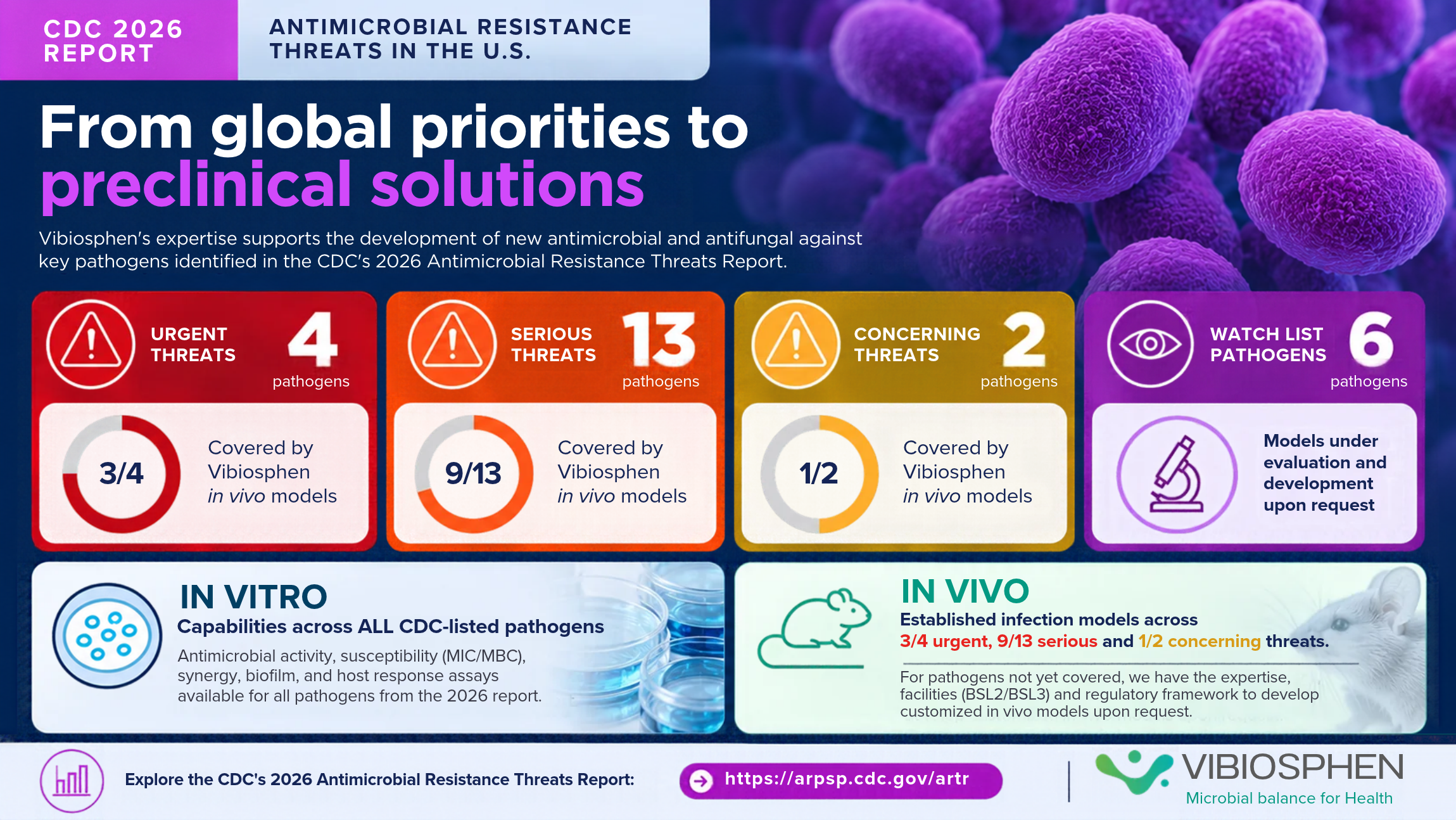
At Vibiosphen, we work with researchers, biotechnology companies and pharmaceutical developers to evaluate new anti-infective candidates through preclinical studies.
As a French Contract Research Organization (CRO) specialising in microbiology and infectious diseases, we provide in vitro, ex vivo and in vivo approaches that can be combined according to the objectives of each development programs.
Our work covers several stages of preclinical evaluation, from initial antimicrobial characterisation to efficacy studies in experimental infection models.
Characterising antimicrobial activity and resistance
Our microbiological assays support the evaluation of antibacterial and antifungal candidates, including:
· MIC and MBC determination.
· Time-kill kinetics and bactericidal activity.
· Antimicrobial combination and synergy testing.
· Resistance development and persister-cell studies.
· Biofilm formation and anti-biofilm activity assessments.
· Bacterial susceptibility to bacteriophages.
· Mechanism-of-action investigations.
These experiments help researchers assess antimicrobial activity, investigate specific biological properties and identify potential limitations before progressing to more complex studies.
They can also support the evaluation of alternative antimicrobial strategies whose activity may not be fully described by conventional susceptibility testing.
Evaluating efficacy in infection models
Vibiosphen provides in vivo infection models to assess candidate efficacy under biological conditions that cannot be reproduced through standard in vitro assays alone.
Depending on the therapeutic indication, our models include:
· Pulmonary infections: evaluation of treatments targeting bacterial and fungal respiratory pathogens.
· Urinary tract infections: assessment of bacterial colonisation and infection involving the upper urinary tract.
· Septicemia and systemic infections: investigation of pathogen dissemination and treatment efficacy.
· Skin and wound infections: evaluation of local antimicrobial activity in infected tissues.
· Thigh infections: assessment of antibacterial efficacy in an established tissue infection model.
· Gastrointestinal infections: evaluation of anti-infective candidates within the intestinal environment.
Microbial burden is often a central endpoint in these studies. Depending on the scientific objectives, it can be combined with pharmacological measurements, inflammatory markers or histological analyses.
This flexibility helps align the experimental design with the questions that need to be answered during development.
Working with clinically relevant pathogens
Vibiosphen's research activities cover several bacterial pathogens associated with clinically important infections and antimicrobial resistance.
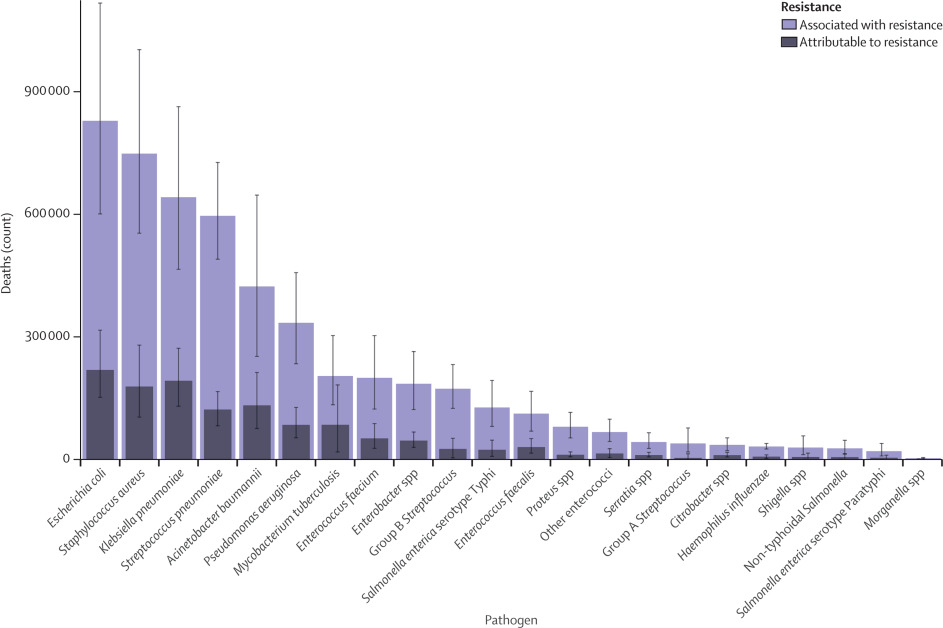
These include Pseudomonas aeruginosa, Acinetobacter baumannii, Klebsiella pneumoniae, Escherichia coli, Staphylococcus aureus and Streptococcus pneumoniae.
Our antifungal expertise also supports the evaluation of candidates targeting relevant fungal pathogens.
The choice of reference strains or clinical isolates depends on the research objectives. Resistance phenotypes, strain availability and model feasibility are evaluated for each programs.
Studies are performed in appropriate biosafety facilities, including BSL2 and BSL3 infrastructures, according to applicable technical, regulatory and ethical requirements.
Adapting studies to different therapeutic strategies
Antimicrobial development increasingly involves approaches with distinct mechanisms of action.
A conventional small molecule, an antimicrobial peptide, a bacteriophage or a biological therapy may require different experimental methods and endpoints.
Our role is to help developers select suitable studies based on the properties of their candidates and the decisions they need to make.
This may involve investigating antimicrobial activity or resistance, testing a combination, evaluating safety, or assessing efficacy in an infection model.
The aim is to generate reproducible preclinical data that can inform the next stage of development.
One Health and the role of preclinical research
The theme of World AMR Awareness Week 2026, "One Health, one action: Prevent AMR now," calls for coordinated efforts to address antimicrobial resistance. [3]
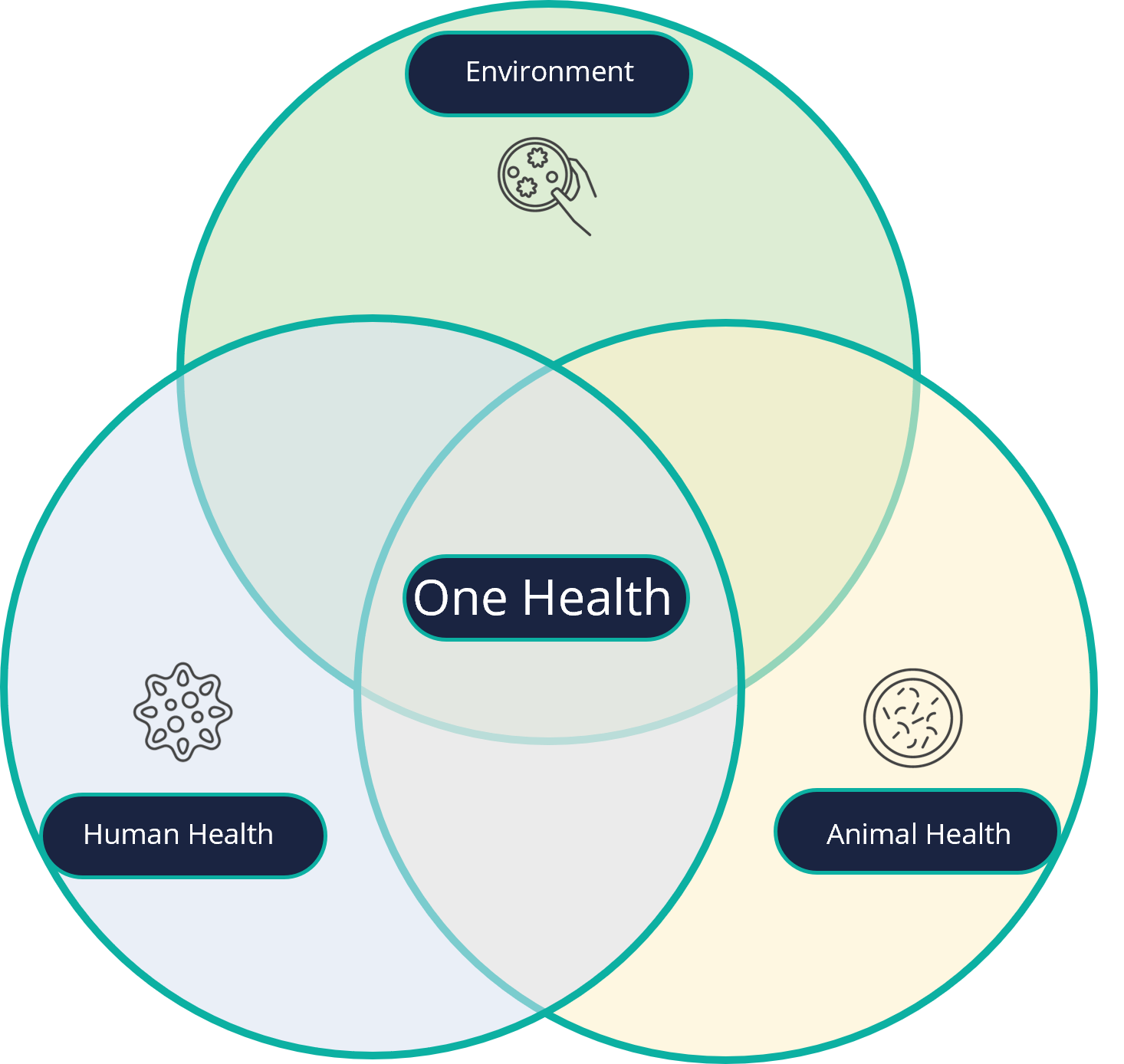
The WHO's updated Global Action Plan on Antimicrobial Resistance (2026–2036) also places One Health at the centre of the international response, recognising the links between human health, animal health, agriculture and the environment. [4]
Addressing AMR requires contributions from different areas of research and healthcare.
Public institutions establish priorities and support surveillance. Healthcare professionals contribute through infection prevention, diagnostics and appropriate antimicrobial use. Academic researchers investigate resistance mechanisms and new therapeutic approaches, while biotechnology and pharmaceutical companies advance treatment candidates through development.
Specialised CROs contribute by designing and conducting experiments that help evaluate these candidates.
For Vibiosphen, this means providing microbiological expertise and preclinical infection models to support teams working on new treatments for infectious diseases.
Turning antimicrobial research into preclinical evidence
The latest WHO figures show that many countries have committed to addressing antimicrobial resistance, although substantial gaps remain between national plans and their implementation.
Developing new therapies is one part of the response.
Promising antimicrobial activity is a starting point. Researchers also need to understand how a candidate behaves under different experimental conditions, whether it retains its activity in relevant biological systems and how its efficacy can be assessed in infection models.
During World AMR Awareness Week 2026, Vibiosphen reaffirms its commitment to supporting this work through specialised preclinical research.
Our contribution is to help developers generate the experimental evidence they need to evaluate new antibacterial, antifungal and other anti-infective strategies.
Microbial balance for health.
References
1. WHO / Quadripartite. Tracking Antimicrobial Resistance Country Self-Assessment Survey (TrACSS), 2026.
https://amrcountryprogress.org/
1b.Reuters. WHO says antimicrobial resistance efforts improve globally but remain off track for 2030 goals, 16 November 2026.
https://www.reuters.com/business/healthcare-pharmaceuticals/who-says-antimicrobial-resistance-efforts-improve-globally-remain-off-track-2030-2026-11-16/
2. WHO. Bacterial Priority Pathogens List, 2024.
https://www.who.int/publications/i/item/9789240093461
3. WHO. World AMR Awareness Week 2026.
https://www.who.int/campaigns/world-amr-awareness-week/world-amr-awareness-week-2026
4. WHO. Updated Global Action Plan on Antimicrobial Resistance (2026–2036), 25 May 2026.
https://www.who.int/news/item/25-05-2026-the-world-health-assembly-adopts-updated-global-action-plan-on-antimicrobial-resistance-%282026-2036%29
5. Vibiosphen. Antibacterial and antifungal in vitro testing.
https://vibiosphen.com/health-antibacterial-and-antifungal
6. Vibiosphen. In vivo infection and inflammation models.
https://vibiosphen.com/health-in-vivo
7. Vibiosphen. From Global AMR Priorities to Preclinical Reality: Reflections from GAMRIC 2026.
https://vibiosphen.com/blog/global-amr-priorities-preclinical-reality-reflections-gamric-2026